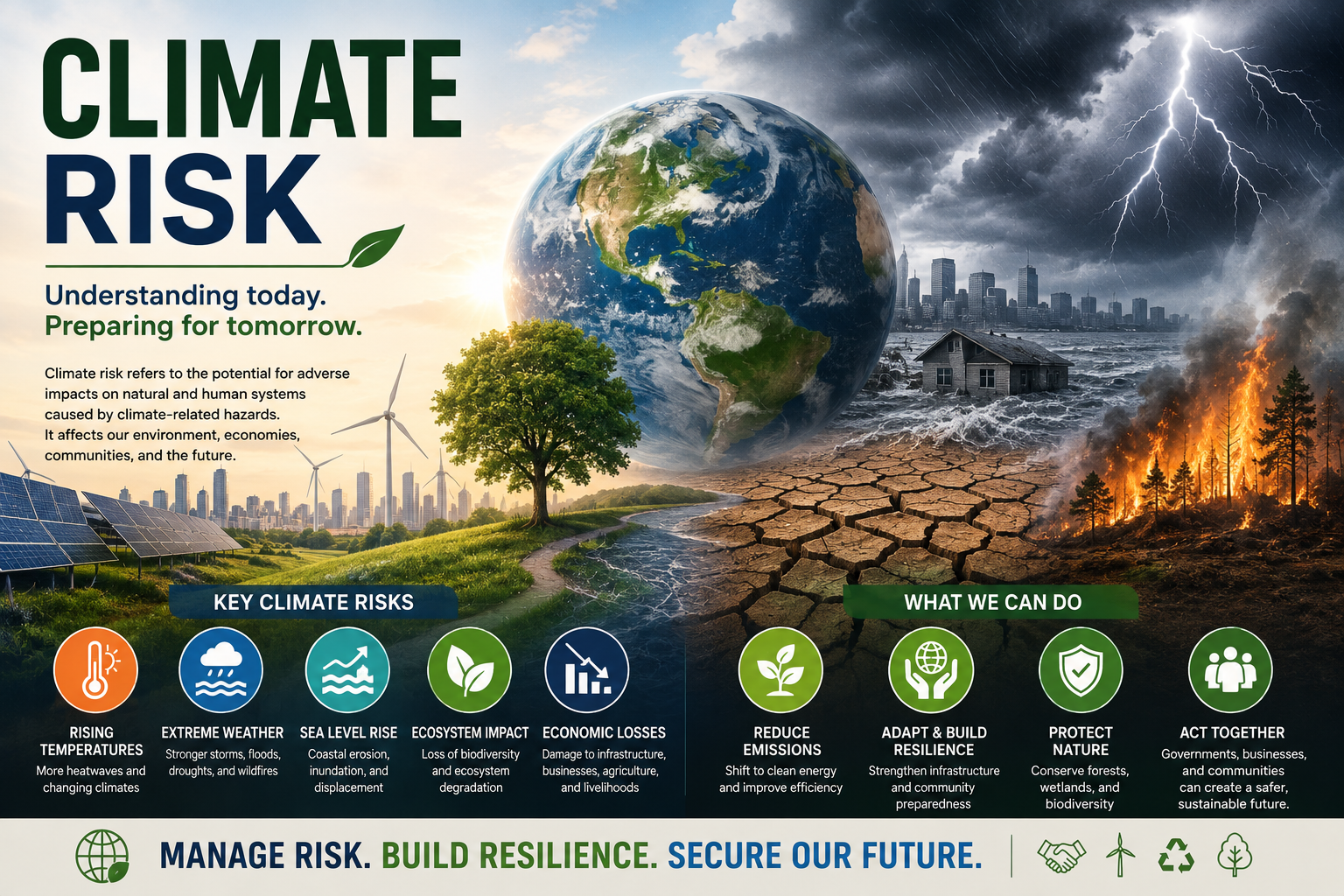
Africa contributes less than 4% of global greenhouse gas emissions, yet it is among the regions most vulnerable to climate change. Rising temperatures, prolonged droughts, floods, cyclones, desertification, and changing rainfall patterns are threatening lives, livelihoods, and economic development across the continent.
Climate risk in Africa is not only an environmental issue—it is also a social, economic, and developmental challenge. Millions of people depend on climate-sensitive sectors such as agriculture, fisheries, and livestock for their livelihoods. As climate-related disasters become more frequent and severe, African countries must strengthen resilience, improve adaptation strategies, and invest in sustainable development.
What is Climate Risk?
Climate risk refers to the possibility that climate-related events such as droughts, floods, heatwaves, storms, and rising temperatures will negatively affect people, businesses, ecosystems, and economies.
Climate risk combines three key factors:
- Hazard: Climate events such as floods or droughts.
- Exposure: People, infrastructure, and assets located in vulnerable areas.
- Vulnerability: The ability of communities to prepare for, respond to, and recover from climate impacts.
Major Climate Risks Facing Africa
| Climate Risk | Description | Regions Most Affected |
|---|---|---|
| Drought | Long periods without rainfall affecting food production | Horn of Africa, Southern Africa, Sahel |
| Flooding | Heavy rainfall causes destruction of homes and infrastructure | West Africa, Central Africa, East Africa |
| Heatwaves | Rising temperatures increase health risks and reduce productivity | North Africa, Southern Africa |
| Desertification | Fertile land becomes dry and unproductive | Sahel Region |
| Coastal Erosion | Rising sea levels threaten coastal communities | Nigeria, Senegal, Mozambique, Egypt |
| Cyclones | Powerful storms damage infrastructure and livelihoods | Mozambique, Madagascar, Malawi |
Causes of Climate Risk in Africa
Several factors contribute to climate risk across the continent.
| Cause | Impact |
|---|---|
| Global Greenhouse Gas Emissions | Rising global temperatures |
| Deforestation | Reduced rainfall and biodiversity loss |
| Rapid Urbanization | Increased flood risk due to poor drainage |
| Land Degradation | Lower agricultural productivity |
| Population Growth | Greater pressure on natural resources |
| Weak Infrastructure | Increased vulnerability during disasters |
Effects of Climate Change on Africa
1. Agriculture
Agriculture employs more than half of Africa’s workforce. Irregular rainfall, droughts, and floods reduce crop yields and livestock productivity.
Major impacts include:
- Reduced food production
- Crop failures
- Livestock deaths
- Increased food prices
- Food insecurity
2. Water Resources
Changing rainfall patterns are reducing freshwater availability in many regions.
| Challenge | Impact |
|---|---|
| Drought | Water shortages |
| Reduced River Flow | Lower hydroelectric power generation |
| Groundwater Depletion | Limited access to clean drinking water |
| Flood Contamination | Increased waterborne diseases |
3. Public Health
Climate change contributes to the spread of diseases and heat-related illnesses.
| Health Risk | Effect |
|---|---|
| Malaria | Expansion into new regions |
| Cholera | Flood contamination |
| Heat Stress | Increased deaths during heatwaves |
| Malnutrition | Reduced food availability |
4. Economic Development
Climate disasters slow economic growth by damaging infrastructure and reducing productivity.
| Sector | Climate Impact |
|---|---|
| Agriculture | Lower yields |
| Tourism | Damage to natural attractions |
| Energy | Reduced hydropower generation |
| Transport | Flood-damaged roads and bridges |
| Fisheries | Declining fish populations |
Countries Most Vulnerable to Climate Risk
| Country | Major Climate Threat |
|---|---|
| Somalia | Severe drought |
| Ethiopia | Drought and floods |
| Kenya | Drought and water scarcity |
| Mozambique | Cyclones and flooding |
| Madagascar | Cyclones and food insecurity |
| Nigeria | Flooding, desertification, coastal erosion |
| Sudan | Desertification and drought |
| Malawi | Cyclones and floods |
Social Impacts of Climate Risk
Climate change affects communities beyond the environment.
- Increased poverty
- Migration and displacement
- Conflicts over water and grazing land
- Reduced school attendance
- Greater pressure on healthcare systems
- Increased unemployment
Strategies for Climate Adaptation
African countries are implementing various measures to reduce climate risks.
| Strategy | Expected Benefit |
|---|---|
| Climate-smart agriculture | Increased crop resilience |
| Irrigation systems | Reduced dependence on rainfall |
| Early warning systems | Better disaster preparedness |
| Renewable energy | Lower carbon emissions |
| Reforestation | Improved biodiversity and rainfall |
| Flood control infrastructure | Reduced damage during heavy rainfall |
| Water conservation | Improved water security |
The Role of Technology
Modern technology is helping Africa manage climate risks.
| Technology | Purpose |
|---|---|
| Satellite Monitoring | Weather forecasting |
| Mobile Weather Alerts | Inform farmers about rainfall |
| Solar Energy | Clean electricity |
| Artificial Intelligence | Climate prediction |
| Geographic Information Systems (GIS) | Disaster mapping |
| Drones | Crop monitoring |
Opportunities for Africa
Although climate change presents serious challenges, it also creates opportunities.
| Opportunity | Benefit |
|---|---|
| Renewable Energy | Job creation and cleaner energy |
| Green Agriculture | Sustainable food production |
| Carbon Markets | New sources of revenue |
| Green Infrastructure | Climate-resilient cities |
| Climate Finance | Funding for adaptation projects |
Recommendations
To reduce climate risks, African governments, businesses, and communities should:
- Invest in renewable energy.
- Improve disaster preparedness and early warning systems.
- Expand climate-smart agriculture.
- Protect forests and wetlands.
- Strengthen water management systems.
- Increase climate education and public awareness.
- Build resilient infrastructure.
- Encourage regional cooperation on climate adaptation.
Conclusion
Climate risk is one of the greatest development challenges facing Africa today. Increasing temperatures, droughts, floods, and extreme weather events threaten food security, water resources, public health, and economic growth. Despite contributing only a small share of global greenhouse gas emissions, African countries bear a disproportionate burden of climate impacts.
Building resilience requires coordinated action from governments, the private sector, communities, and international partners. Investments in climate-smart agriculture, renewable energy, resilient infrastructure, early warning systems, and sustainable natural resource management can help protect lives and livelihoods. By taking proactive steps today, Africa can reduce climate risks, strengthen its economies, and create a more sustainable future for generations to come.
Frequently Asked Questions (FAQs)
| Question | Answer |
|---|---|
| What is climate risk? | The likelihood of negative impacts caused by climate-related hazards such as floods, droughts, and heatwaves. |
| Why is Africa highly vulnerable to climate change? | Many economies rely on climate-sensitive sectors like agriculture, and limited resources can reduce the capacity to adapt. |
| Which African countries are most affected? | Somalia, Ethiopia, Kenya, Nigeria, Mozambique, Madagascar, Sudan, and Malawi are among the most vulnerable. |
| How does climate change affect agriculture? | It reduces crop yields, increases livestock losses, and threatens food security. |
| What can be done to reduce climate risk? | Climate-smart agriculture, renewable energy, reforestation, resilient infrastructure, early warning systems, and better water management are key solutions. |